Why Situationships Are Addictive (And Why They're So Hard to Leave)

Updated: Oct 12
You're practically dating. You're emotionally invested. And somehow, asking where things are going still feels like a scheduling conflict.
The texts are frequent. The chemistry is real. You spend time together, share personal stories, and occasionally behave like a couple.
There's just one minor detail.
Nobody seems particularly interested in defining what's happening.
Welcome to the situationship.
An undefined connection isn't necessarily a problem when both people genuinely want something casual.
The trouble begins when you're hoping for a relationship while repeatedly accepting an arrangement that isn't moving toward one.
The connection may be real. That doesn't mean the relationship you want is being built.
Is This Going Somewhere, or Just Continuing?
Before another month passes in the same undefined situation, explore the free Mixed Signals Decoder Method preview.
It introduces practical questions about communication, planning, effort, and follow-through.
The Difference Between Chemistry and Progress
Situationships can feel especially compelling because meaningful moments coexist with uncertainty.
One weekend is wonderful.
The next week, communication slows.
Then comes another lovely evening, and suddenly you're reconsidering every concern you had.
The enjoyable moments aren't necessarily fake.
They're simply not the entire picture.
Ask yourself:
Are we spending time together because we're building something?
Or are we repeating enjoyable experiences without discussing what either of us wants?
Communication maintains contact. Progression changes the relationship.
A connection can move slowly and still develop.
But when nothing changes month after month, slow may have become stagnant.
Why It's So Hard to Leave a Situationship
Sometimes leaving means giving up more than the relationship that currently exists.
It means giving up the relationship you imagined it could become.
The vacations you discussed.
The future plans that sounded promising.
The version of him who seemed just one conversation away from being ready.
That's the difficult part.
You're not only considering what you'd lose today.
You're also considering what might never happen tomorrow.
But possibility isn't the same as a plan.
And potential doesn't automatically become progress because you've invested more time in it.
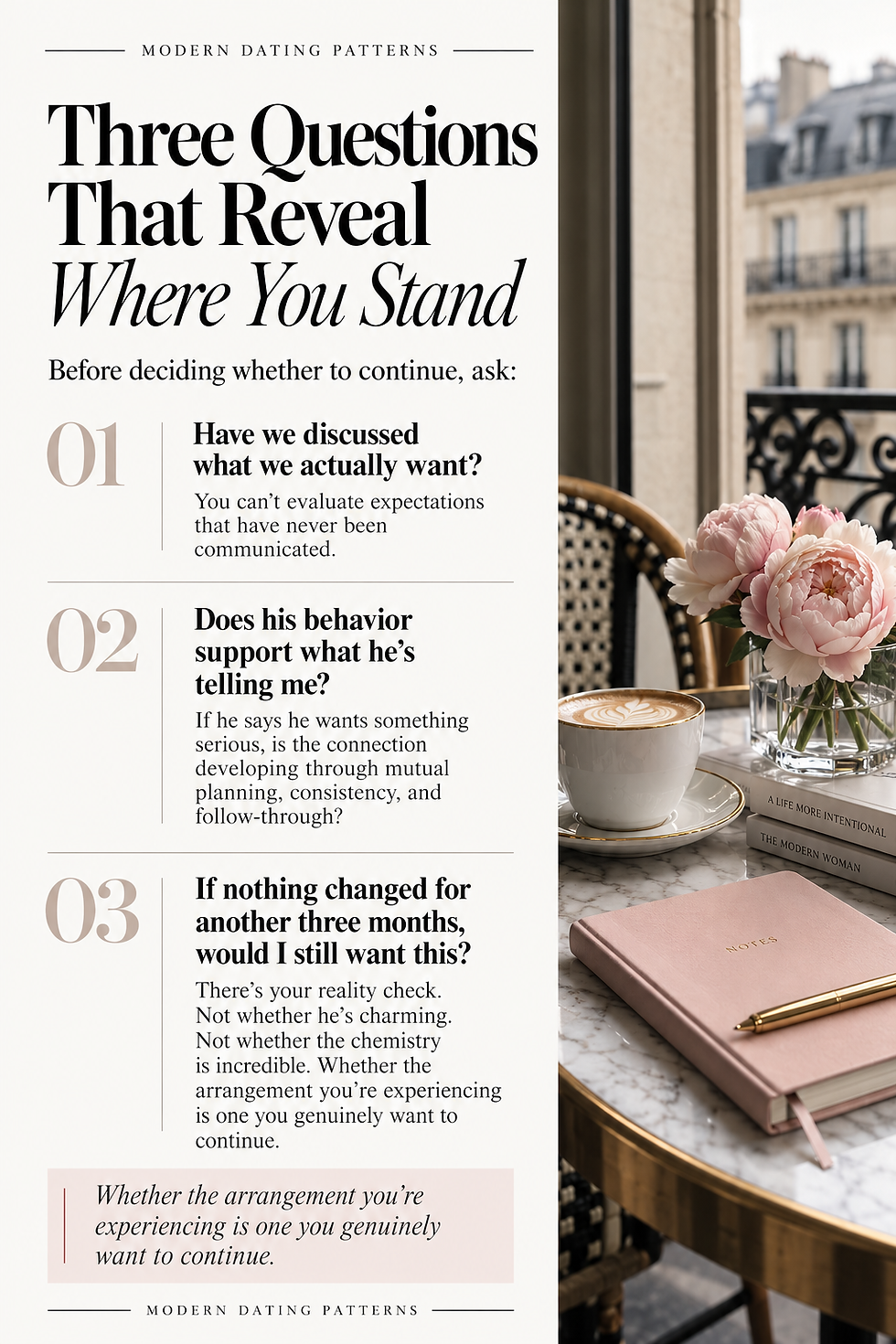
How to Leave a Situationship Without Waiting Forever
You don't have to deliver an ultimatum or pretend you're suddenly indifferent.
You can communicate what you're looking for, ask whether your expectations align, and observe the response.
If the connection continues to offer less than you want, you're allowed to decide it isn't for you.
You don't need to prove that he's a bad person.
You need to decide whether this is a suitable relationship for you.
Stop Dating the Possibility. Evaluate the Pattern.
The complete Mixed Signals Decoder Method helps you examine what is consistently happening, rather than relying on promising conversations or occasional romantic moments.
Paid digital dating tool.
A situationship doesn't have to be meaningless to be going nowhere. And you don't have to stay simply because it could become something more.


Comments